Digital Marketing vs. Traditional Marketing
In today’s competitive environment, how you position your products and services in the market is crucial, because where the audience is, that’s where the scope lies for your products and services to generate interest.
Marketing has always been about connecting businesses with customers — but how that connection happens has changed dramatically. With the rise of the internet, smartphones, and social platforms, digital marketing has transformed the way brands reach and engage their audiences.
So what exactly is digital marketing, and how does it differ from traditional marketing? Let’s break it down in a clear, practical way.
What is Digital Marketing?
Digital marketing refers to all marketing efforts that use digital channels and technologies to promote products or services.

It includes strategies such as:
- Search engine optimization (SEO
- Social media marketing
- Email marketing
- Content marketing
- Pay-per-click (PPC) advertising
- Influencer and affiliate marketing
Digital marketing allows businesses to reach audiences online, where people now spend most of their time—searching, scrolling, shopping, and streaming.
What Is Traditional Marketing?
Traditional marketing uses offline channels to promote products or services. These methods were dominant before the internet became widespread.
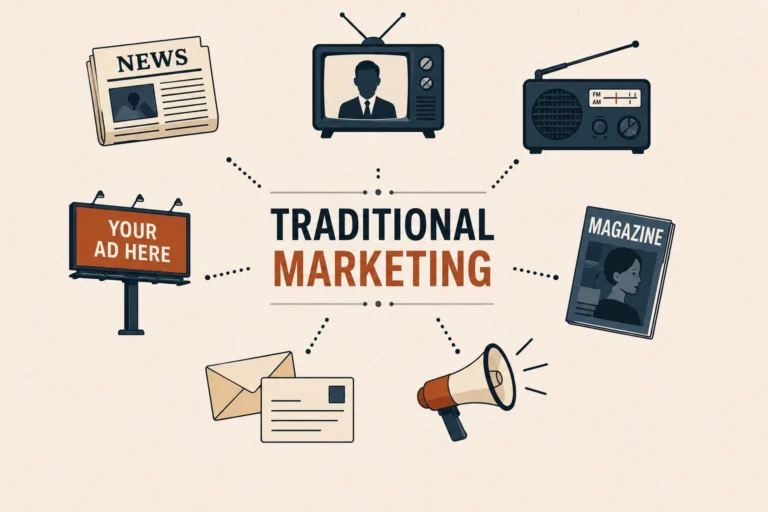
Common traditional marketing channels include:
- Television commercials
- Radio ads
- Newspaper and magazine ads
- Billboards and posters
- Flyers and brochures
- Direct mail
Traditional marketing focuses on broad audience exposure rather than personalized engagement like digital marketing.
Digital Marketing vs Traditional Marketing: Key Differences
Let’s explore these two marketing approaches below:
1. Medium and Reach
Digital Marketing: Reaches audiences online through websites, apps, and platforms—often globally
Traditional Marketing: Reaches audiences offline and is usually limited by geography
Digital marketing allows brands to connect with users anytime, anywhere.
2. Targeting and Personalization
Digital Marketing: Highly targeted based on age, interests, behavior, location, and intent
Traditional Marketing: Broad targeting with limited personalization
Digital marketing delivers the right message to the right audience at the right time.
3. Measurability and Analytics
Digital Marketing: Every action can be tracked—clicks, views, conversions, ROI
Traditional Marketing: Results are difficult to measure accurately
With digital marketing, decisions are data-driven rather than based on guesswork.
4. Customer Interaction
Digital Marketing: Two-way communication through comments, messages, reviews, and engagement
Traditional Marketing: One-way communication from brand to audience
Digital channels encourage conversations and relationship-building.
5. Cost and Budget Flexibility
Digital Marketing: Cost-effective, scalable, and suitable for small budgets
Traditional Marketing: Often expensive with high upfront costs
Digital marketing allows businesses to start small, test campaigns, and scale what works.
6. Speed and Adaptability
Digital Marketing: Campaigns can be launched, adjusted, or paused instantly
Traditional Marketing: Changes are slow and often costly once launched
Digital marketing offers agility in fast-changing markets.
7. Long-Term Value
Digital Marketing: Builds long-term assets like content, SEO rankings, and email lists
Traditional Marketing: Usually provides short-term exposure
Digital strategies often compound in value over time.
Can Digital and Traditional Marketing Work Together?
Absolutely.
Many successful brands use a hybrid approach, combining:
- Traditional marketing for mass awareness and credibility
- Digital marketing for targeting, engagement, and conversion
The key is aligning both methods with business goals and audience behavior.
Final Thoughts
Digital marketing and traditional marketing share the same goal—driving awareness, engagement, and sales—but they achieve it in very different ways.
Digital marketing stands out for its precision, measurability, cost-effectiveness, and interactivity, making it the preferred choice in today’s connected world. Traditional marketing still has value, but digital marketing offers the flexibility and insight modern businesses need to grow.
Understanding the difference helps businesses choose the right mix — and build smarter, more effective marketing strategies.