
The 4 Pillars of SEO: A Comprehensive Guide to Sustainable Growth
Search Engine Optimization (SEO) is not a single tactic; it is a holistic strategy. To dominate the search results, you must address the ecosystem of your website from both the inside out and the outside in. Industry experts often group these strategies into four fundamentals pillars. Think of these as the legs of a table — if one is weak, the entire structure becomes unstable.
Industry experts often group these strategies into four fundamental pillars. Think of these as the legs of a table—if one is weak, the entire structure becomes unstable.
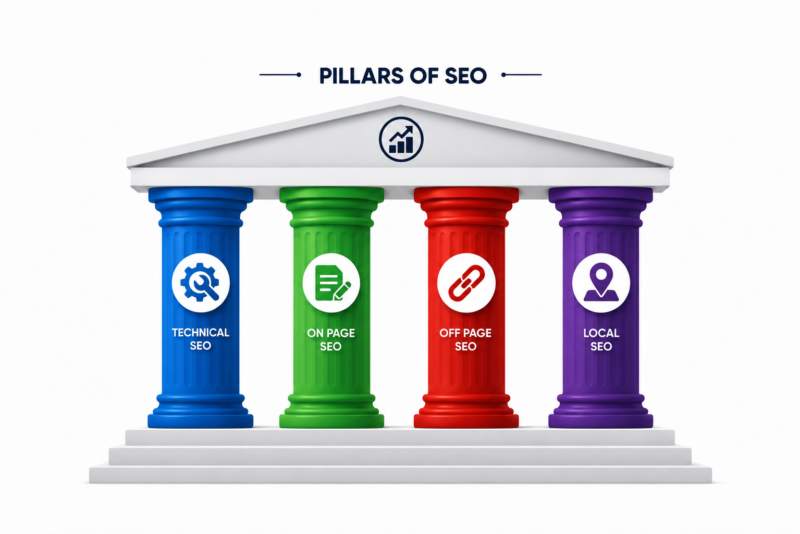
1. Technical SEO: The Foundation
Technical SEO is the behind-the-scenes work that ensures search engine bots can effectively crawl, index, and understand your website. If your site has technical flaws, even the best content may never reach the top of the search results.
Crawlability & Indexability: Use robots.txt and XML sitemaps to guide search engines to the most important parts of your site.
Site Speed: Users and search engines love fast websites. Optimize images, leverage browser caching, and minimize code.
Mobile-Friendliness: With Google’s mobile-first indexing, your site must provide a seamless experience on smartphones and tablets.
Security (HTTPS): A secure site is a basic trust signal for search engines.
2. On-Page SEO: The Content & Structure
On-Page SEO involves optimizing the elements on your individual webpages to ensure they are relevant to user search queries and easy for search engines to interpret. It is about “what” you are saying to your audience.
Keyword Optimization: Research and strategically place target keywords in your titles, headings, and throughout the body text.
Meta Tags: Write compelling meta titles and descriptions to improve click-through rates (CTR) from search results.
Internal Linking: Connect your pages logically to help users navigate and to distribute “authority” across your site.
Content Quality: Focus on E-E-A-T (Experience, Expertise, Authoritativeness, and Trustworthiness) to create value that keeps users engaged.
3. Off-Page SEO: The Authority Builder
If On-Page SEO is what you say about yourself, Off-Page SEO is what others say about you. It involves activities performed outside your website to signal to search engines that your site is a credible, authoritative source.
Backlink Building: The primary engine of off-page SEO. Earning links from reputable, high-authority websites is a strong endorsement of your content’s value.
Social Signals: While not a direct ranking factor, social media engagement drives traffic and brand awareness, which indirectly aids your SEO efforts.
Brand Mentions & PR: Getting your brand name mentioned on news sites or industry blogs builds trust and topical authority.
4. Local SEO: The Geographic Edge
For businesses with a physical location or those serving specific geographic areas, Local SEO is essential. It ensures you appear when potential customers search for “near me” services or specific regional keywords.
Google Business Profile (GBP): This is the single most important asset for local SEO. Keep your name, address, and phone number (NAP) consistent across the web.
Local Citations: Ensure your business is listed accurately in local directories (Yelp, Yellow Pages, etc.).
Customer Reviews: Positive, frequent reviews directly influence your visibility in the “Local Pack” (the map listing at the top of search results).
By balancing these four pillars, you create a robust, resilient strategy that not only helps you rank higher but also provides a superior experience for your users.